This guide is for anyone whose dog turns every walk into a tug-of-war: owners of strong medium and large dogs, new adopters, parents pushing a stroller, and anyone who wants a gentler option than a collar for a dog that pulls. We picked the best no-pull dog harnesses by comparing hands-on testing from Business Insider, Wirecutter, The Spruce Pets, and Whole Dog Journal, plus manufacturer specs and owner feedback.
The short answer: the PetSafe Easy Walk Comfort is the best no-pull dog harness for most dogs. It’s Business Insider’s best overall pick, with a front martingale loop that tightens slightly when your dog pulls, padding throughout, and a top handle. If you want the most adjustable fit, certified trainer Alisa Healy, writing for The Spruce Pets, picks the Blue-9 Balance Harness. For a lower tier, the Rabbitgoo No-Pull Harness is the budget pick in The Spruce Pets’ November 17, 2026 general harness guide (its March 2025 guide for dogs that pull instead names the 2 Hounds Freedom as the budget option). This is research-based, not a hands-on test by The Nested. No harness replaces loose-leash training, and Wirecutter notes that no harness, even one labeled no-pull, will eliminate pulling on its own.
Disclosure: This article contains affiliate links. As an Amazon Associate I earn from qualifying purchases.
The Shortlist
Quick Picks
Six no-pull and front-clip harnesses worth a look, from the lowest tier to a premium everyday pick. All are sold new on Amazon right now.

PetSafe Easy Walk Comfort No-Pull Harness
$$$ Business Insider’s best overall. A front martingale loop, padding everywhere it touches, a top handle, and a back clip for running.
Check price on Amazon ↗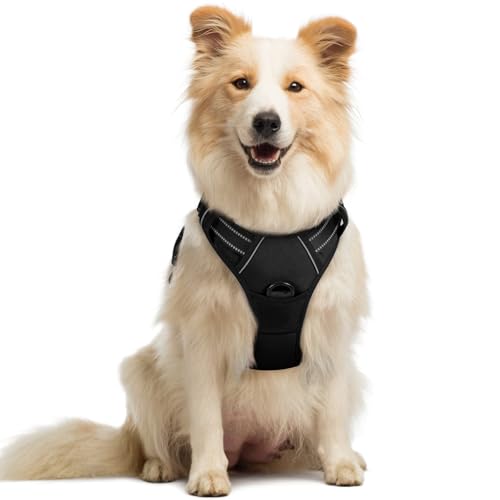
Rabbitgoo No-Pull Dog Harness
$ The budget pick in The Spruce Pets’ 2026 general harness guide. Padded, with front and back clips, a top handle, and reflective strips.
Check price on Amazon ↗
PetSafe Easy Walk 3 in 1 No-Pull Harness
$$ Business Insider’s budget pick. A neck buckle means nothing goes over the head, and it has a seat belt loop for the car.
Check price on Amazon ↗
Blue-9 Balance Harness
$$$ Six adjustment points and a Y-shaped neck that stays off the shoulders. A trainer’s top pick at The Spruce Pets.
Check price on Amazon ↗
2 Hounds Design Freedom No-Pull Harness
$$$ Wirecutter’s pick for larger breeds. Velvet-lined chest strap, stainless hardware, and sizes for very large dogs. A harness still will not stop pulling on its own.
Check price on Amazon ↗
Ruffwear Front Range Harness
$$$$ Wirecutter’s top everyday dog harness. Ruffwear calls it a padded everyday harness with a front clip to redirect dogs that pull. Business Insider found it curbs pulling less than true no-pull designs.
Check price on Amazon ↗Price guide: $ budget · $$ mid-range · $$$ premium · $$$$ top-end. Tiers compare the harnesses on this page, based on Amazon prices for a medium size when we wrote this. Prices change often and vary by size and color, so tap through for today’s price.
Side by Side
No-Pull Dog Harness Comparison Table
| Harness | Leash points | How it goes on | Adjustment points | Padding | Best for | Price tier |
|---|---|---|---|---|---|---|
| PetSafe Easy Walk Comfort No-Pull Harness | Front martingale loop + back | Over the head | 5 | Full-body padding | Most dogs that pull | $$$ |
| Rabbitgoo No-Pull Dog Harness | Front + back | Over the head, 2 side buckles | 4 | Padded, mesh lined | Budget buyers, handle use | $ |
| PetSafe Easy Walk 3 in 1 No-Pull Harness | Front + back | Neck buckle (not over the head) | 5 | Light padding | Head-shy dogs, car rides | $$ |
| Blue-9 Balance Harness | Front + back D-rings | Neck buckle (not over the head) | 6 | Soft-touch nylon webbing | Hard-to-fit body shapes | $$$ |
| 2 Hounds Design Freedom No-Pull Harness | Front + back (martingale at back) | Takes practice to fit | 4 | Velvet-lined chest strap | Large, strong pullers | $$$ |
| Ruffwear Front Range Harness | Front loop + back V-ring | Over the head | 4 | Foam-padded chest and belly | Hikes, all-day wear | $$$$ |
Specs come from the manufacturers, Amazon listings, and Business Insider. Adjustment counts are the makers’ own figures.
The Details
Product Reviews
PetSafe Easy Walk Comfort No-Pull Harness
The Easy Walk Comfort is Business Insider’s best no-pull harness overall. Its testers walked three dogs from 14 to 80 pounds in it and found it highly effective at preventing pulling. A 40-pound mixed breed stopped pulling without her gait being thrown off, and a 12-pound Chihuahua-terrier mix got a snug fit with no straps digging into his armpits. The key is the front martingale loop: when the dog pulls, it tightens and adds gentle pressure that discourages pulling. That is not a promise it stops pulling on the first use, even though some Amazon title wording says so.
PetSafe lists full-body padding, a front loop for training, a back clip for running, a top handle, and reflective material on the black and blue colors. The Amazon listing, Business Insider, and PetSafe’s own feature list all say it has five adjustment points; the same official product page’s spec box says 4. Use five as the working figure, and treat the spec-box 4 as a conflict on PetSafe’s page. Business Insider lists four sizes for chests from 13 to 42 inches. It isn’t a magic fix: with an 80-pound, still-learning golden retriever, the tester noticed some slack at the chest at his hardest pulls and he wasn’t fully redirected, though it kept him from dragging her. Small hardware on the extra-small size was also fiddly to adjust.
Worth knowing: this is not the original Easy Walk. Business Insider disqualified the original version for significant sagging during testing. Whole Dog Journal, reviewing the original Easy Walk, found considerable sagging and slippage in the chest martingale loop, and that the chest strap crosses the shoulders. The padded Comfort version is the one to buy.
Who it’s for: Most dogs that pull, from small terriers to big retrievers, especially if you want one harness that works for both training and everyday walks.
Pros
- Business Insider’s best overall no-pull harness
- Front martingale loop discourages pulling
- Padded throughout, with a top handle
- Back clip for running or calm walks
- Wide size range
Cons
- Goes over the head, which some dogs dislike
- Very strong pullers may not be fully redirected
- Small hardware on the extra-small size is fiddly
Rabbitgoo No-Pull Dog Harness
If you want the lowest tier on this page, the Rabbitgoo is a good place to start. In its November 17, 2026 guide to the best dog harnesses, The Spruce Pets names it the best budget dog harness, praising its padded construction, four adjustment points, front and back leash clips, quick-release buckles, mesh lining, top handle, and reflective stitching. Its main knock: the straps might be too wide for smaller dogs. (The Spruce Pets’ March 10, 2025 guide to harnesses for dogs that pull instead calls the 2 Hounds Freedom its budget option.)
Business Insider’s testers looked at the Rabbitgoo Classic Fit No-Pull Harness as a handle harness and found it as effective at restraining a lunging dog as their top handle pick. They also found its buckles easier to work one-handed and its padding thicker, which suits thin-coated dogs but may run hot in warm weather. Rabbitgoo describes it as an entry-level front-clip harness with four adjustment points and two quick-release side buckles. The medium on Amazon lists a chest range of about 15 to 27.8 inches, so measure before you order.
Who it’s for: Budget-minded owners of medium and large dogs, and anyone who wants a handle for quick control at crosswalks or around other dogs.
Pros
- Lowest price tier on this page
- Front and back clips plus a sturdy top handle
- Padded, mesh-lined vest
- Reflective strips for night walks
Cons
- Padding can run warm in hot weather
- Straps may be too wide for small dogs
- Slips over the head
PetSafe Easy Walk 3 in 1 No-Pull Harness
Business Insider calls the PetSafe Easy Walk 3 in 1 its best budget no-pull harness. A shelter volunteer who tested it with untrained dogs was impressed with how well it managed strong pulling and said there’s little chance a dog can wriggle out of it. It has a Y-shaped design, light neoprene padding, reflective stitching, and a neck buckle, so you never have to pull it over your dog’s head.
PetSafe lists five adjustment points and a gray seat belt loop for using it as a car restraint, and the Amazon listing says it handles light to moderate pulling. Business Insider notes that the car feature hasn’t been crash-tested and may not protect your dog in an accident. It’s also heavier than similar harnesses, which can feel bulky on small dogs, and its plastic clasps aren’t padded.
Who it’s for: Medium and large dogs that duck away from over-the-head harnesses, and owners who want one harness for walks and short car rides.
Pros
- Neck buckle, so nothing goes over the head
- Five adjustment points
- Front and back leash points plus a top handle
- Seat belt loop for car rides
Cons
- Car restraint isn’t crash-tested
- Heavier and bulkier than similar harnesses
- Unpadded plastic clasps
Blue-9 Balance Harness
Certified dog trainer Alisa Healy, writing for The Spruce Pets, makes the Balance Harness her top pick for dogs that pull and says it’s what she recommends to most of her training clients. She likes that it sits higher than many harnesses, leaving the shoulders free, and that she has fit it on dogs from stocky bulldogs to narrow whippets. It was also Business Insider’s former top pick, and its testers found it made untrained shelter dogs much easier to walk.
Blue-9 lists six adjustment points, front and back leash rings, a buckle on the neck loop for dogs that don’t like things over their heads, and washable nylon. The catches: both The Spruce Pets and Business Insider say there’s a learning curve to putting it on, and Business Insider found it can sit too far back on short-torsoed dogs. Blue-9’s fitting guide also notes that all front-attachment harnesses slide to one side with strong pullers, which is normal.
Who it’s for: Dogs with hard-to-fit bodies (deep chests, wide necks, narrow waists) and owners who are working on loose-leash training with a trainer.
Pros
- Six adjustment points for a custom fit
- Y-shaped neck stays off the shoulders
- Neck buckle, so it goes on like a collar
- Front and back rings for a double-ended leash
Cons
- Takes some practice to put on
- Can sit too far back on short-torsoed dogs
- No foam padding listed, unlike the PetSafe Comfort or Ruffwear
2 Hounds Design Freedom No-Pull Harness
The Freedom is a longtime favorite for strong dogs. Wirecutter’s harness guide names it best for larger breeds, and says a harness will not stop pulling behavior, though this one helps you get a bit more control while you train, and Whole Dog Journal named it the best affordable no-pull harness, calling it virtually impossible to get out of when properly fitted and praising its construction. Whole Dog Journal also says it was a bit complicated to fit at first but got easier with use.
2 Hounds Design lists a front and back connection, a martingale loop on the back that tightens gently around the chest when your dog pulls, a Swiss velvet lining to prevent rubbing behind the front legs, and stainless steel hardware. Its official sizing page tells you to measure the largest part of the chest and pick the smallest size that still fits. Wirecutter says the largest size can handle dogs up to, and even over, 125 pounds. One tradeoff from The Spruce Pets: the Freedom’s shoulder strap is a bit restrictive, and the Blue-9 sits higher so the shoulders can move more freely.
Who it’s for: Large and strong dogs, escape-prone dogs, and owners who want a durable harness in lots of colors.
Pros
- Wirecutter’s pick for larger breeds
- Hard to escape when fitted correctly
- Velvet-lined chest strap helps prevent chafing
- Sizes for very large dogs
Cons
- Fiddly to fit the first few times
- Shoulder strap sits lower than Y-shaped designs
- Fewer adjustment points than the Blue-9
Ruffwear Front Range Harness
The Front Range is not a dedicated no-pull harness. Ruffwear describes it as a padded everyday dog harness with two leash points: an aluminum V-ring on the back for everyday walks, and a reinforced front clip at the chest “to redirect dogs that pull on leash.” It also lists foam padding in the chest and belly panels, four points of adjustment, and, if you’re between sizes, to choose the larger size. Wirecutter still names it the top dog harness overall: a sturdy, lightly padded, head-in harness with reflective trim and a hidden ID pocket, in sizes for chests from 13 to 42 inches. In the same guide, a photo caption notes the chest can twist if the fit is loose, which a strap adjustment fixed. Business Insider calls it the best padded harness and says one tester’s dog has worn the same one for seven years.
Here’s the catch for this no-pull guide: Business Insider found it doesn’t curb pulling as well as its other no-pull picks, because the chest piece twists and slides to the side with repeated pulling. Wirecutter adds that it may be too bulky for some smaller dogs.
Who it’s for: Hikers and owners who want a comfortable everyday or trail harness with a front clip for redirecting, not a dedicated no-pull training tool.
Pros
- Wirecutter’s top dog harness overall
- Foam-padded and comfortable for long wear
- ID pocket, reflective trim, and a light loop
- Durable, according to long-term owners
Cons
- Not a true no-pull design; Business Insider found it curbs pulling less than the dedicated picks
- Goes over the head
- Highest tier on this page
Buying Advice
How To Choose a No-Pull Dog Harness
Use the front clip
The front attachment is what does the work. According to the American Kennel Club, front-clip harnesses help redirect a dog’s forward movement and may discourage pulling, and you can switch to the back clip as your dog gets more reliable. That is a “may,” not a guarantee that pulling stops. Consumer Reports points out that a harness can make it comfortable for a dog to pull hard. It cites Southern Illinois University research, published in the Journal of Veterinary Behavior, that found dogs pulled almost twice as hard in a harness as on a flat nylon collar. The harness in that study was a padded back-clip design, per New Scientist, which puts the average difference at about 60 percent. So the finding compares back-clip harnesses with collars, not front-clip no-pull designs.
Choose the shape: Y-front or across the chest
Y-shaped harnesses, like the Blue-9 and PetSafe 3 in 1, sit above the shoulder joint. A veterinarian quoted by Business Insider calls Y-shaped designs non-restrictive, and The Spruce Pets’ trainer prefers them for shoulder movement. Straps that run straight across the chest can be more restrictive, so watch your dog’s gait on the first few walks.
Measure, then fit it snug
Measure around the widest part of the rib cage, just behind the front legs, and follow each maker’s size chart. They differ: 2 Hounds says to pick the smallest size that fits, while Ruffwear says to size up if you’re between sizes. The AKC’s vet source says you should have to squeeze two fingers under the straps, but not so tight it’s uncomfortable. Consumer Reports suggests testing a controlled escape in a safe area by stepping on the leash in front of your dog.
Decide how it goes on
If your dog ducks away from anything over the head, choose a neck-buckle design like the Blue-9 or PetSafe 3 in 1. Over-the-head styles, like the PetSafe Comfort, Rabbitgoo, and Ruffwear, are quick once your dog is used to them.
Pair the harness with training
A harness is a tool, not a cure. Wirecutter, citing trainers and a veterinary behaviorist, says no harness will eliminate pulling behavior, even if it is labeled “no pull,” though a front clip may make training a little easier. A Southern Illinois University professor, Erin Perry, told Consumer Reports, “There is no magic collar or harness.” Reward your dog for walking on a loose leash, and keep a collar with ID tags on too, as the trainer in Consumer Reports’ guide recommends. For dogs that do slip out, a GPS dog collar adds a backup, and a pet camera helps you check in on a dog who’s still learning house manners. Cat owners can see our guide to escape-proof cat harnesses.
Questions
FAQ
What is the best no-pull dog harness?
For most dogs, the PetSafe Easy Walk Comfort. It’s Business Insider’s best overall, with a front martingale loop, full padding, and a top handle. For the most adjustable fit, consider the Blue-9 Balance Harness; for a lower tier, the Rabbitgoo No-Pull Harness.
Do no-pull harnesses actually work?
They can help, but they don’t train your dog for you, and they do not guarantee that pulling stops. Wirecutter says no harness will eliminate pulling on its own. Business Insider’s testers found front-clip designs made pulling easier to manage, yet even its top pick didn’t fully redirect an 80-pound puller. Consumer Reports and Business Insider both say to pair a harness with loose-leash training.
Is a front-clip or back-clip harness better for a dog that pulls?
Front-clip. The AKC says the front attachment helps redirect a pulling dog. A back clip is better for calm walks, running, or dog sports where pulling is the goal.
Are no-pull harnesses bad for a dog’s shoulders?
A badly fitted one can be. Consumer Reports quotes a veterinary professor who warns that a dog that keeps pulling in a front-clip harness can have its natural gait inhibited. Y-shaped designs that stay off the shoulders, like the Blue-9, are considered less restrictive by the trainers and vets quoted by The Spruce Pets and Business Insider.
How tight should a no-pull harness be?
Snug, but not tight. The AKC‘s vet source says you should have to squeeze two fingers under the straps. If your dog can back out when you step on the leash in a safe area, tighten it or go down a size.
Is a harness better than a collar for a dog that pulls?
For a dog that pulls, a harness is usually the safer place to clip the leash. A veterinarian quoted by Business Insider says dogs that pull on a collar are at higher risk of choking. The AKC notes a harness is not automatically better for every dog, but dogs that pull may benefit because it can reduce neck strain. Keep a flat collar on for ID tags, and clip the leash to the harness.
Can I use a no-pull harness in the car?
Only some offer a car feature, and most aren’t crash-tested. Business Insider notes the PetSafe 3 in 1’s seat belt loop hasn’t been crash-tested. For car rides, a crash-tested restraint is safer, and our dog seat covers guide helps protect your back seat.
What to Buy
What To Buy First
For most dogs that pull, buy the PetSafe Easy Walk Comfort $$$. It’s the best no-pull dog harness for everyday walks, with a front martingale loop, real padding, and a handle.
On a tight budget? Get the Rabbitgoo No-Pull Harness $. Dog hates things over its head? The PetSafe Easy Walk 3 in 1 $$. Hard-to-fit body shape? The Blue-9 Balance Harness $$$. Big, strong puller or escape artist? The 2 Hounds Design Freedom $$$. Want a comfortable everyday or trail harness, and pulling is only mild? The Ruffwear Front Range $$$$ is Wirecutter’s top everyday pick, not a true no-pull design.
Tap through to Amazon for today’s price and shipping. As an Amazon Associate I earn from qualifying purchases. The Nested may also earn a commission on purchases made through other links on this page at no extra cost to you. We have not hands-on tested these harnesses, and this isn’t personalized veterinary or training advice. Sources include Business Insider, Wirecutter, The Spruce Pets (harnesses for dogs that pull), The Spruce Pets (best dog harnesses), Whole Dog Journal, Consumer Reports, the AKC, and the manufacturers’ product pages and Amazon listings. Hero photo: Diana ✨ / Pexels. After a long walk, an orthopedic dog bed and a pet water fountain help your dog recover.